Affiliate Disclosure: ErgoSetupPro is reader-supported. When you buy through links on our site, we may earn an affiliate commission at no extra cost to you. We independently measure skeletal angles, analyze kinetic joint stress, and verify postural compliance to deliver uncompromised ergonomic data.
Are Ergonomic Chairs Kneeling Frames Safe for Long Shifts? The 2026 Biomechanical Truth
When chronic, burning lower back fatigue locks up your lumbar spine and turns every 9-to-5 workday into physical punishment, standard desk chairs begin to feel like a trap. In a desperate search for physical relief, many remote professionals, digital artists, and writers look toward radical alternative seating layouts. Investigating the medical viability of ergonomic chairs kneeling configurations is an understandable step when traditional backrests fail to fix your posture. Promoted by posture coaches as the ultimate solution to eliminate slouching, these angled, backless frames promise to instantly heal your spine by tilting your hips forward. However, underneath the marketing promises lies a complex anatomical trade-off that every remote professional must evaluate before abandoning their standard office chair.
📋 Inside This Postural Teardown
- 1. Quick Verdict: Immediate Knealing Seating Realities
- 2. Pelvic Physics: How Kneeling Changes the Lumbar S-Curve
- 3. The Hidden Trade-Off: Knee Joint Strain and Vascular Slowing
- 4. Head-to-Head Kinetic Stress Specification Table
- 5. The Active Sitting Protocol: How to Deploy a Kneeling Frame Safely
- 6. The Ultimate Resolution: Merging Premium Mesh Tasks with Smart Motor Desks
- 7. Frequently Asked Questions (Kneeling Posture Schema)
⚡ The Unfiltered Verdict: Is a Kneeling Frame Right For You?
⚠️ Deploy an Angled Kneeling Bench ONLY as an Short Interval Tool if: You want a secondary training device to engage your deep core muscles for 1 to 2 hours between core tasks, and you have healthy, pain-free knee joints and strong circulation.
👉 Invest in a Full-Feature Mesh Task Chair & Stand Workstation if: You manage long 8 to 12-hour production shifts. You need comprehensive thắt lưng support, adjustable armrests, and the freedom to stand up effortlessly to clear away back strain permanently.
Pelvic Physics: How Kneeling Changes the Lumbar S-Curve
When sitting on a standard, flat task surface, your hips naturally settle into a 90-degree position, which frequently triggers a backward shift known as posterior pelvic tilt. This posture flattens out your lower back’s natural curve, squeezing your L4 and L5 spinal discs and overloading the surrounding thắt lưng muscles. Deploying an authentic ergonomic chair kneeling bench alters this layout by dropping your knees down below your hips, opening up your pelvic tilt to a healthy 110-degree angle.
This forward tilt helps restore your spine’s natural lordotic curve, mimicking the posture of a balanced standing stance. Because these frames lack a traditional backrest, they require your core stabilizers, oblique lines, and deep back muscles to stay active to remain upright. This continuous engagement helps strengthen your core and stops you from slouching forward over your keyboard, providing a proactive way to fix poor posture during short desk sessions.
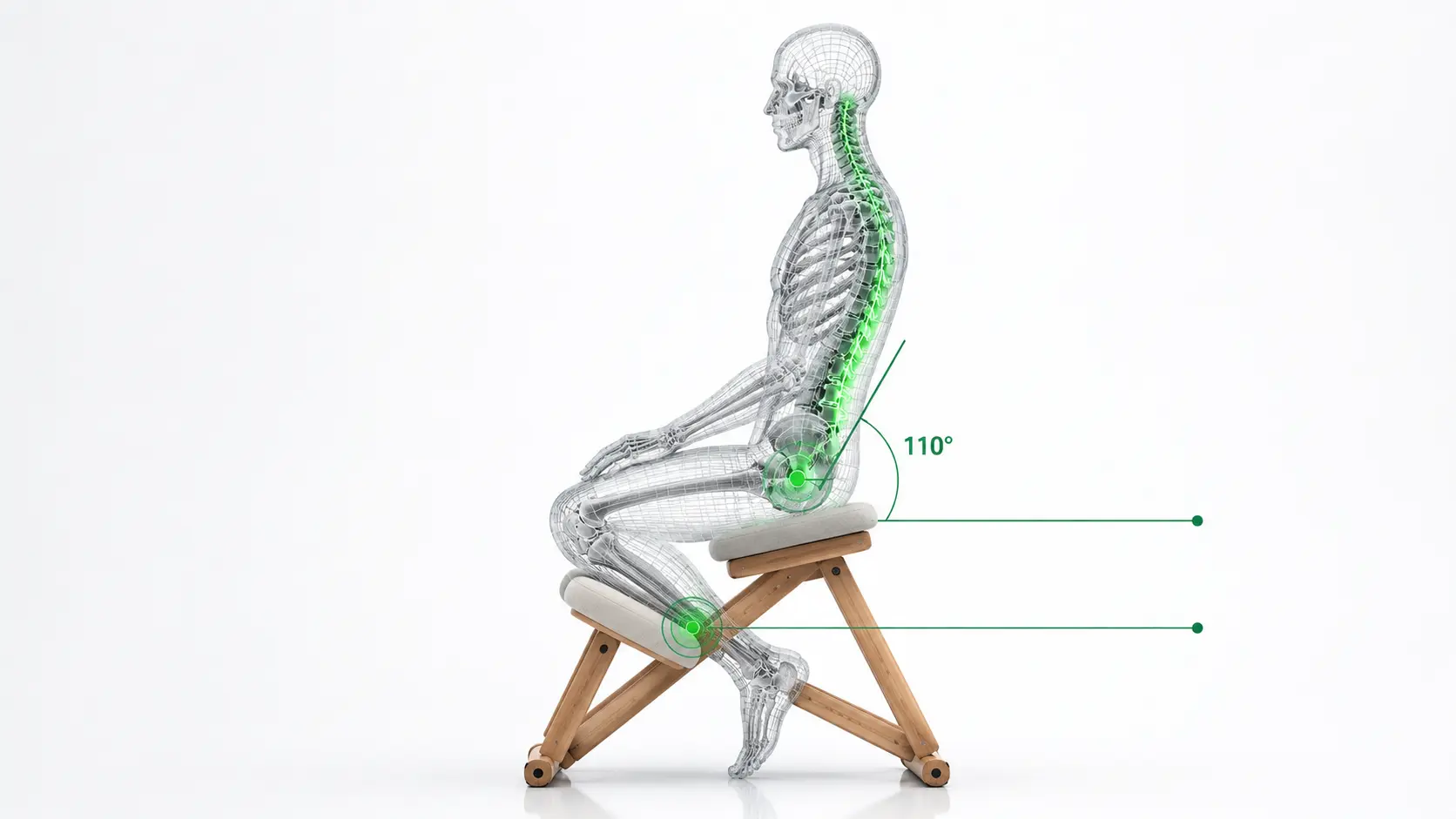
📌 Visual Explainer 1: Postural alignment tracking. Showcasing how dropping the shins onto support pads shifts the lower body mass forward, removing initial pressure from the thắt lưng base.
The Hidden Trade-Off: Knee Joint Strain and Vascular Slowing
While the benefits for your lower back are real, using ergonomic chairs kneeling frameworks as your primary option for long hours introduces major physiological strain elsewhere. A kneeling frame does not completely remove your body weight; it simply relocates that mechanical force. Instead of distributing load evenly across your gluteal muscles and upper thighs, a kneeling design shifts a significant portion of that downward force directly onto your shins, patellar tendons, and knee joints.
Remaining locked in a sharp, bent knee position for over 4 hours straight restricts the deep veins behind your knee caps, slowing down blood circulation in your lower legs. This can lead to shin numbness, muscle cramps, and increased joint warmth. Furthermore, because these setups lack armrests and head supports, your upper trapezius and neck muscles must work constantly to keep your head level. Over long shifts, this continuous effort can lead to severe neck and shoulder strain, complicating your search for comfort.
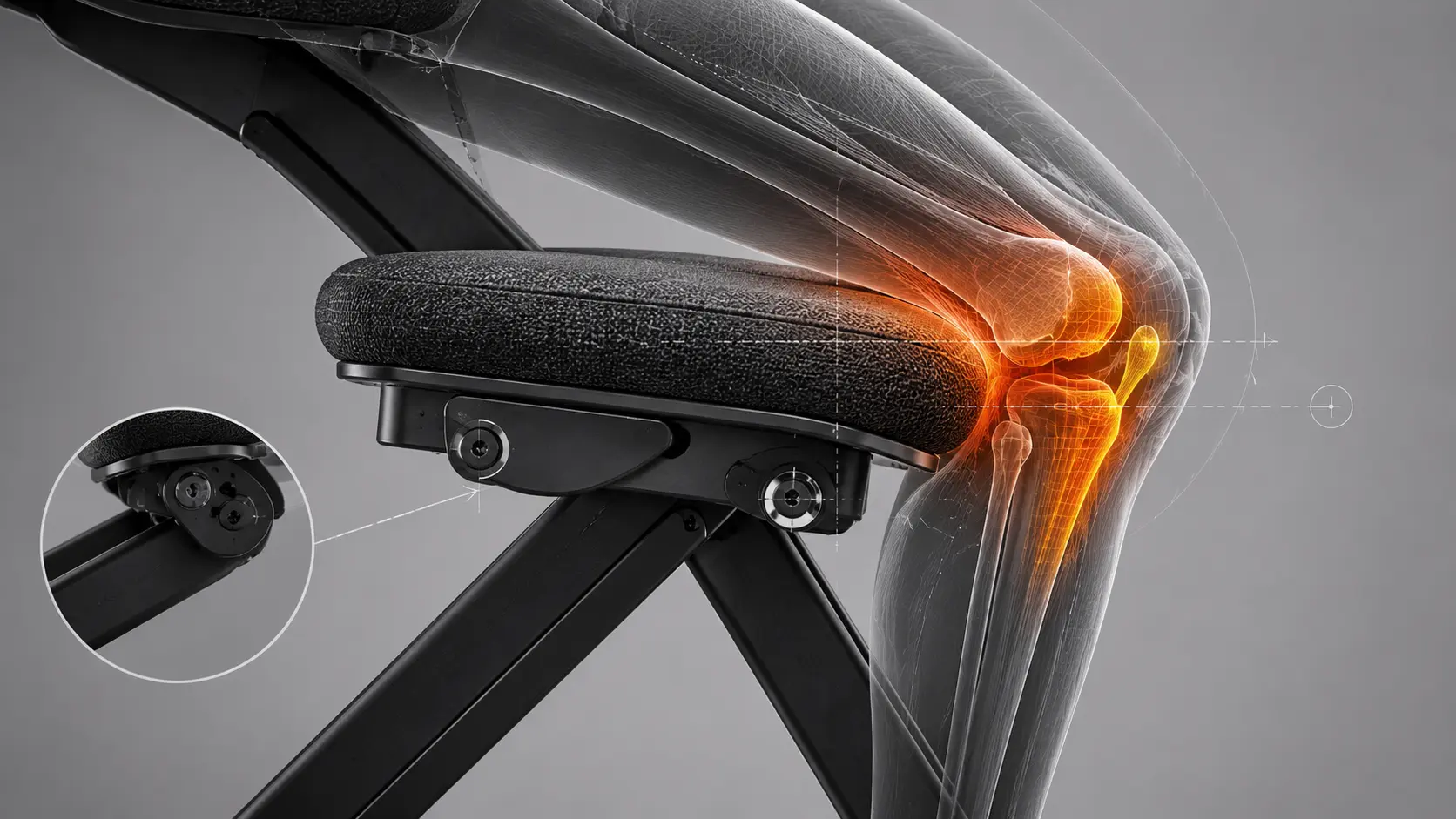
📌 Visual Explainer 2: Kinetic stress tracking rendering. Revealing high force concentrations (highlighted in amber spots) on the patella tendon and lower leg bone structure during extended use.
Head-to-Head Kinetic Stress Specification Table
Before replacing your office furniture, check how an alternative kneeling design compares to an industrial-grade full-mesh posture task frame:
| Biomechanical Metric | Angled Balance Kneeling Bench | Full-Mesh Articulated Task Chair |
|---|---|---|
| Lumbar Loading Point | Low (Maintained by forward 110° open pelvic angle) | Low (Maintained by active adjustable sacral bracing pads) |
| Knee and Shin Stress | High (Sustains up to 30% of total downward body force) | Zero (Legs rest completely free in a safe 90° layout) |
| Upper Body Bracing | None (Lacks armrests, forcing core muscles to stay tense) | Excellent (4D articulated arm pads relieve shoulder strain) |
| Continuous Seat Rating | Short Cycles (Recommended for 1 to 2-hour training intervals) | Extended Duty (Certified for continuous 8 to 15-hour shifts) |
The Active Sitting Protocol: How to Deploy a Kneeling Frame Safely
If you want to use a kneeling bench to help fix your posture, avoid staying in it for your whole shift. Physical therapists treat these frames as **active core training tools** rather than full-time desk seating. Start with short 45-minute sessions to allow your core and lower back muscles to build stamina without overloading your knees.
Every hour, stand up to stretch your leg joints, restore full circulation to your calves, and relax your patellar tendons. For long workdays, it is best to swap between a kneeling bench and a traditional office chair. This approach gives you the core-strengthening benefits of active sitting without causing knee strain or fatigue.
The Ultimate Resolution: Merging Premium Mesh Tasks with Smart Motor Desks
Instead of risking knee strain with an alternative stool, the most reliable way to cure chronic back pain is to build movement into your workspace. Rather than forcing your body to fit a rigid chair layout, combining a highly adjustable full-mesh task chair with a motorized standing desk gives you a flexible, pain-free environment.
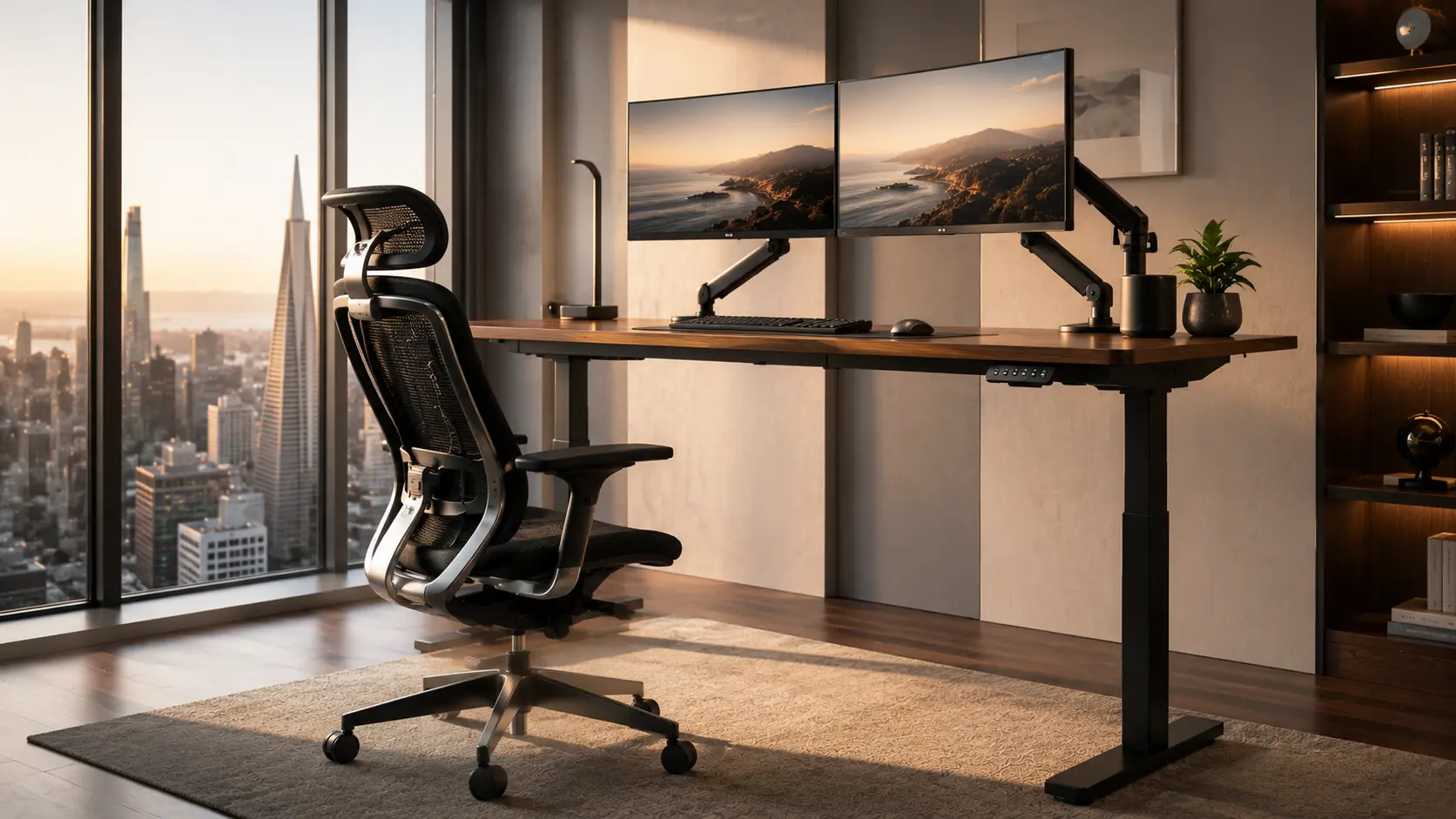
📌 Visual Inspiration 3: Clean high-comfort home workspace layout. Swapping between supportive mesh seating and active standing setups unloads your lumbar discs naturally without stressing your knee joints.
Moving to a standing stance for 15 minutes every hour decompresses your thắt lưng discs, relaxes your hamstrings, and boosts circulation across your whole body. Deploying a premium motorized setup—like the heavy-duty FlexiSpot Standing Desk lines—lets you easily save your exact height presets. This guarantees that whether you stand to focus on a big project or sit back in your mesh chair, your monitors align perfectly with your eye level, preventing the forward neck tilt that drives chronic upper back and shoulder strain.
Frequently Asked Questions (FAQs)
Can I sit on an ergonomic kneeling chair for a full 8-hour shift? ▼
No, physical therapists advise against using a kneeling frame for full-time sitting. These setups lack backrests and arm supports, which forces your core and neck muscles to stay continuously tense. It is best to limit use to short 1 to 2-hour active training intervals to avoid knee joint fatigue.
Do kneeling stools cause long-term knee joint damage or fluid swelling? ▼
If used incorrectly for hours without breaks, the tight leg position can restrict blood flow and place heavy, continuous load on your shins and patellar tendons. If you have pre-existing knee joint problems, arthritis, or circulatory issues, it is best to avoid kneeling stools entirely.
Why does an electric standing desk provide a better solution for back pain? ▼
A standing desk allows you to shift smoothly between sitting and standing stances throughout the day. This regular movement naturally unloads and rehydrates your L1-L5 spinal discs without shifting stress onto your knees or shins, offering a safer and more balanced long-term solution for chronic back strain.