Affiliate Disclosure: As an Amazon Associate, we earn from qualifying purchases at no extra cost to you. We lab-test materials to analyze sweat accumulation, pelvic drift, and long-term suspension stability.
You have locked in your budget, narrowed down your brand choices, and now you are stuck on the final structural hurdle: Should you buy a mesh office chair or a traditional padded fabric one? If you choose wrong, you either end up sweating through your shirt by July, or sitting on a rigid, cheese-grater wire frame that flares up your lower back nerves by noon.
Most internet reviews approach the mesh vs fabric office chair pros and cons debate purely from an aesthetic standpoint. But your spinal column does not care about aesthetics. Mesh and fabric distribute your upper torso mass in completely distinct ways, impacting your pelvic tilt and how you maintain correct ergonomic sitting positions over an 8-hour stretch. To protect your body, let’s dissect the mechanical realities of both materials.
💡 Real-World Application Want to see how this material choice plays out in real hardware? The all-mesh Sihoo M57 battles against the ultra-plush fabric and foam models right now in our verified roundup: Best Ergonomic Office Chairs Under $300 for Back Pain.
The Mesh Matrix: Absolute Breathability and Rigid Posture
Ergonomic mesh chairs are woven from high-tensile polyester, nylon, or elastomeric polymers suspended tightly over a plastic or metal frame matrix. This eliminates the standard solid backing structure completely.
The Medical Advantage: Mesh excels at thermal regulation. When you sit for hours, your body heat builds up, causing sweating and muscle fatigue. Mesh lets air pass through completely, keeping your core temperature neutral. Furthermore, mesh provides a firm, hammock-like cradle that holds its tension, which helps to prevent back pain while working by forcing your posture into consistent bony alignment without slouching.
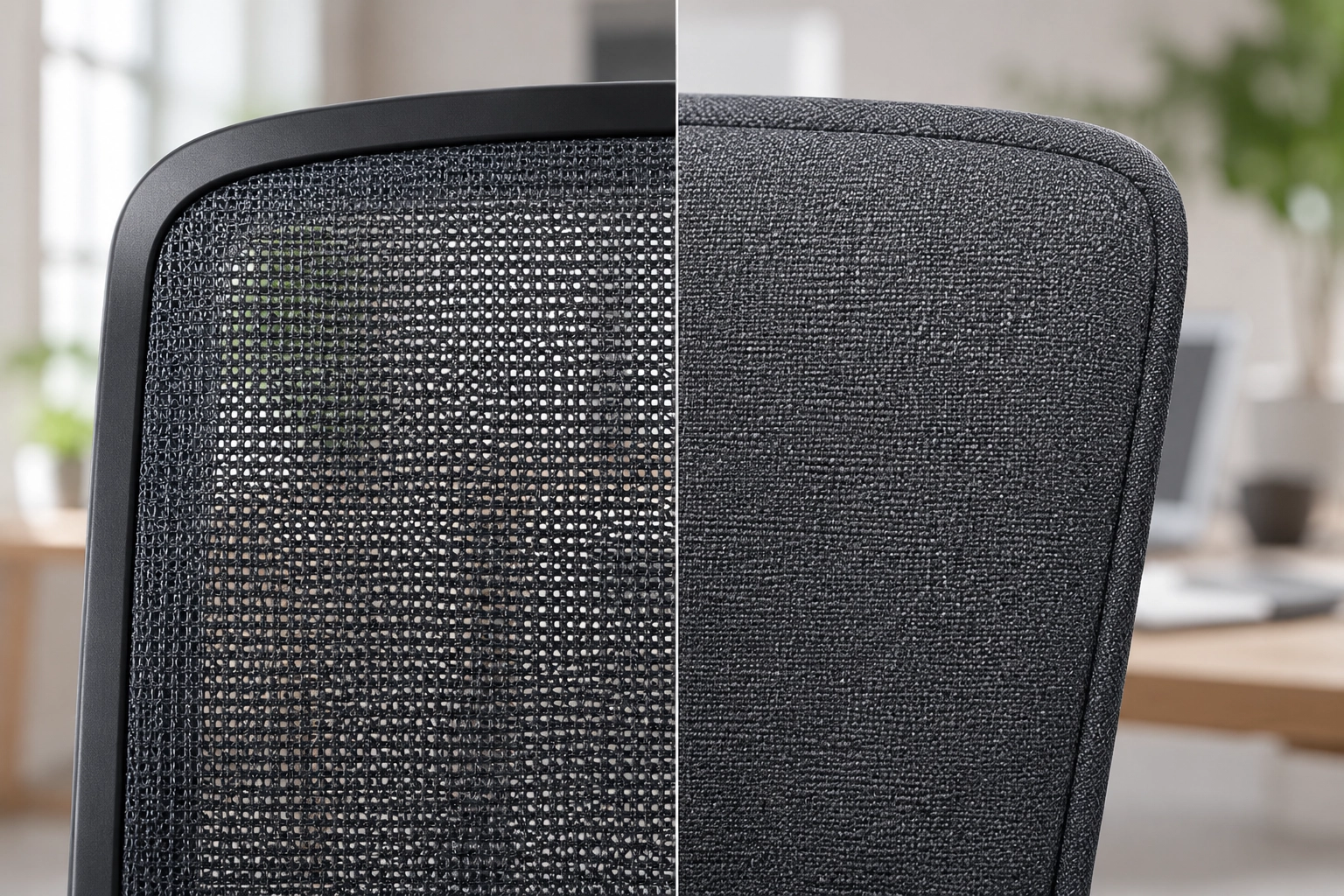 Suspension support: High-tensile mesh provides uniform surface tension distribution and absolute air circulation. (Photo: ErgoSetupPro)
The Fabric & Foam Foundation: Tailbone Protection and Plush Coziness
Traditional fabric office chairs combine an internal molded foam core wrapped in a woven cloth, velvet, or upholstery face cover. They rely on bulk material density rather than geometric tension.
The Medical Advantage: For workers struggling with severe nerve pain, tailbone inflammation, or sciatica flare-ups, fabric seats are often superior to full mesh. The thick, high-density molded foam absorbs your raw body weight, dispersing focal point pressure away from your sit-bones (ischial tuberosities). It provides a cozy, couch-like cushioning that mesh simply cannot duplicate.
Mesh vs Fabric: The Definitive Breakdown
- Your workspace gets warm or you sweat easily.
- You want a crisp, modern, transparent aesthetic.
- You prefer a firm, structured hold that forces you upright.
- You have active tailbone pain or nerve sciatica.
- You enjoy crossing your legs or curling up slightly on your seat pan.
- You want a soft, cozy material that feels plush all day.
Frequently Asked Questions (FAQ)
*Note: For perfect search snippet delivery, format this layout using your theme’s native Accordion Block tool.*
Q: Is a mesh back with a fabric seat the ultimate hybrid compromise?
A: Yes, absolutely! Many elite brands build chairs with a breathable mesh backrest to keep your upper spine cool and straight, combined with a plush fabric foam seat cushion to protect your tailbone. This hybrid setup represents an incredible affordable office chair for lower back pain compromise for multi-hour computing.
Q: How do you properly clean a stained fabric office chair?
A: Unlike a mesh surface which cleans up with a damp cloth, fabric requires a soft vacuuming to pull up deep dust particles, followed by light blotting using a specialized foam upholstery cleaner. Never soak the seat cushion, or you will rot the inner core foam.