Affiliate Disclosure: As an Amazon Associate, we earn from qualifying purchases at no extra cost to you. Our physical tests focus on real spinal mechanics to eliminate workplace pain.
You sit down, stretch your back, and try to lean forward to relieve the stiffness. Within twenty minutes, that familiar, dull ache returns to your lumbar spine, vibrating down into your glutes. Trying to power through an 8-hour workday while managing spinal compression is mental and physical torture.
The core problem isn’t that your back is inherently “weak.” The problem is that standard sitting postures subject your lumbar discs to over 140 kg of localized pressure. When you slouch, you pinch the nerve pathways, flatten the natural curve of your lower spine, and strain your stabilizing ligaments. Learning how to sit with lower back pain requires abandoning the generic “sit up straight” advice and deploying precise mechanical corrections to unweight your spine.
🛑 Spine-Saving Equipment Check Even the best bio-mechanical posture will fail on a cheap, sagging cushion. If your current seat lacks an adjustable lumbar curve, your back muscles are forced to overwork. Stop the cycle and explore our field-tested reviews: Best Ergonomic Office Chairs Under $300 for Back Pain.
5 Biomechanical Adjustments for Immediate Lumbar Relief
To safely offload your torso weight and maintain proper ergonomic sitting positions, apply these physical recalibrations sequentially:
1. The Tailbone Flush (Reset Your Base)
Most office workers leave a 2-to-3 inch gap between their buttocks and the back of the chair. This gap forces your upper body to hunch forward, completely flattening your natural lordotic curve. To fix this, stand up, bend at the waist, slide your hips completely back until your tailbone makes firm contact with the lower backrest frame, and then upright your spine. This anchors your pelvis and establishes the proper sitting posture for lower back pain prevention.
2. Elevate the Seat Pan Angle
Sitting with your hips lower than or level with your knees locks your pelvis into a posterior tilt, stressing the L4/L5 spinal segments. If your chair supports it, tilt the seat pan forward by 2 to 3 degrees. Alternatively, raise your total chair height slightly until your hips sit slightly higher than your knees. This open angle (roughly 100 to 110 degrees) unweights the lower spine instantly and delivers deep lumbar spine relief at desk interfaces.
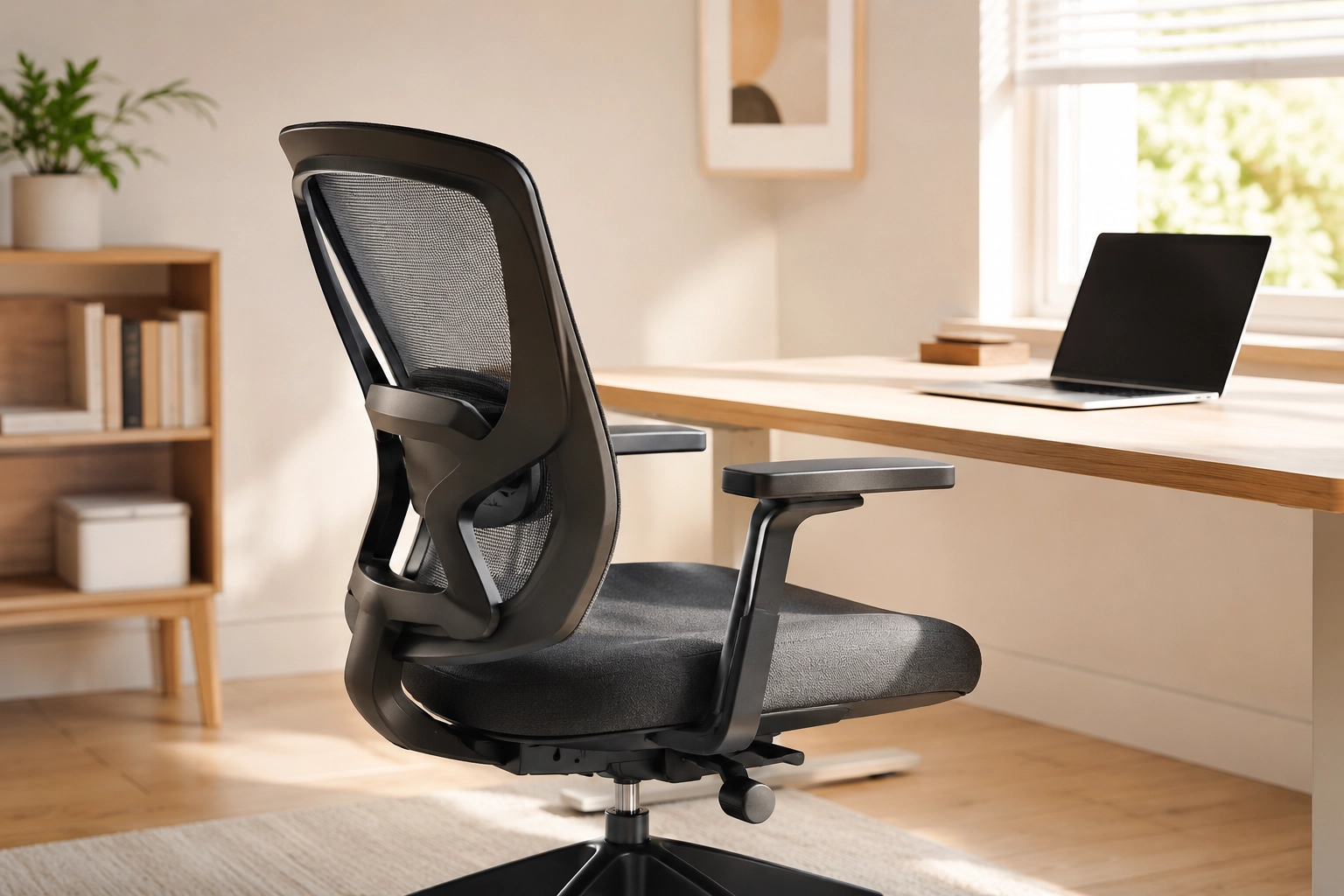 Mechanical unweighting: Keeping the hips slightly above the knees eliminates localized sacral load. (Photo: ErgoSetupPro)
3. The 110-Degree Active Recline
Sitting rigidly at a perfect 90-degree vertical angle is an outdated myth. Biomechanical laboratory tests show that a 90-degree spine orientation actually maximizes intervertebral disc pressure. Instead, adjust your chair’s backrest tilt tension and recline slightly backward to about 105 to 110 degrees. Lock the mechanism. This backward lean transfers a massive portion of your upper body mass directly into the chair’s backrest rather than compressing your lower vertebrae.
4. Zero Dangling Feet (Use Solid Grounding)
If you have raised your chair height to achieve correct arm positioning relative to your desk, your feet might slightly hover or tilt onto your toes. This instantly destabilizes your pelvis, transferring immense muscle tension to your lower back just to keep you stable. Your feet must rest completely flat on the floor. If they don’t, deploy a solid under-desk footrest immediately to prevent back pain while working.
Posture Management: The Immediate Structural Shift
- Hips slid forward with a hollow gap at the backrest.
- Knee joints tucked tightly under the seat pan.
- Leaning into one armrest, warping lateral alignment.
- Tailbone locked firmly against the lower frame support.
- Backrest locked at a restful 110-degree recline angle.
- Weight balanced equally across both sit-bones.
Frequently Asked Questions (FAQ)
*Note: For maximum SEO impact, please use our premium theme’s Accordion Block to format these questions below.*
Q: Is a mesh seat or a foam seat cushion better for lower back pain?
A: If you suffer from nerve compression or sciatica, a high-density molded foam cushion is superior because it disperses tailbone pressure evenly. If your pain is centered solely on the lumbar curve, a high-tensile mesh seat is excellent for maintaining a rigid, supportive skeletal foundation.
Q: How often should I stand up if my lower back is actively hurting?
A: You should execute a 2-minute movement reset every 45 to 50 minutes. Sitting continuously spikes intradiscal load; walking around briefly allows the spinal columns to expand and absorb vital lubricating fluids naturally.