Affiliate Disclosure: ErgoSetupPro is reader-supported. When you buy through links on our site, we may earn an affiliate commission at no extra cost to you. We independently inspect stationary structural skids, balance-test bell glides, and verify core stability mechanics to deliver uncompromised ergonomic data.
Best Ergonomic Chair No Wheels Options: The 2026 Stationary Posture Blueprint
Constant micro-drifting across hardwood flooring, deep gouges on expensive laminate, and the frustrating instability that forces your core muscles to brace against unwanted movement are persistent flaws of rolling task seating. For remote professionals, home studio producers, and clinicians who demand locked-in precision, sourcing an ergonomic chair no wheels configuration is a vital ergonomic refinement. Traditional rolling casters introduce micro-instability that alters your pelvic alignment every time you reach across a desk. To achieve pure, distraction-free focus, you need a high-performance stationary task frame engineered with stationary sled bases or heavy-duty bell glides that anchor your foundation without sacrificing lumbar contouring.
📋 Inside This Stationary Seating Blueprint
- 1. Quick Verdict: Immediate Stationary Frame Selections
- 2. Biomechanical Anchoring: Why Rolling Casters Trigger Core Fatigue
- 3. Three Pillars of a Superior Stationary Ergonomic Task Chair
- 4. Head-to-Head Base Architecture Specification Table
- 5. Lifestyle Clusters: Matching Stationary Designs to Your Flooring
- 6. The Dynamic Station: Anchored Seating with Smart Standing Desks
- 7. Retrofit Engineering: Converting Premium Mesh Chairs with Bell Glides
- 8. Frequently Asked Questions (Wheel-Free Schema)
⚡ The Quick Verdict: Selecting Your Zero-Drift Frame
👉 Choose an Engineered Sled-Base Mesh Chair if: You work on thick pile carpet or sensitive hardwood floors. You need a dedicated cantilever or 4-leg tubular frame that spreads downward pressure across a wide floor surface while maintaining active lumbar curvature.
👉 Choose a Swivel Task Chair with Stationary Bell Glides if: You require pneumatic height adjustment and 360-degree rotation without any unwanted floor travel. This delivers high-end posture mechanics with a locked, stationary footprint.
Biomechanical Anchoring: Why Rolling Casters Trigger Core Fatigue
Standard office chairs rely on dual-wheel nylon casters designed for swift movement across smooth surfaces. However, on hard surfaces like polished concrete, engineered hardwood, or tile, these wheels allow the chair to shift under tiny shifts in body weight. Every time you push against your desk, press a foot pedal, or adjust your monitors, the chair rolls backward by fractions of an inch.
This subtle drifting triggers unconscious postural compensations. Your abdominal stabilizers, hip flexors, and calf muscles remain in a low-level, continuous state of tension to prevent the chair from sliding away. Over an 8-hour shift, this micro-bracing fatigues the pelvic girdle and causes users to slump into a posterior pelvic tilt. Choosing an ergonomic desk chair no wheels setup completely removes this kinetic float, anchoring your feet firmly to the floor and allowing your lower back to relax completely against the lumbar backrest.
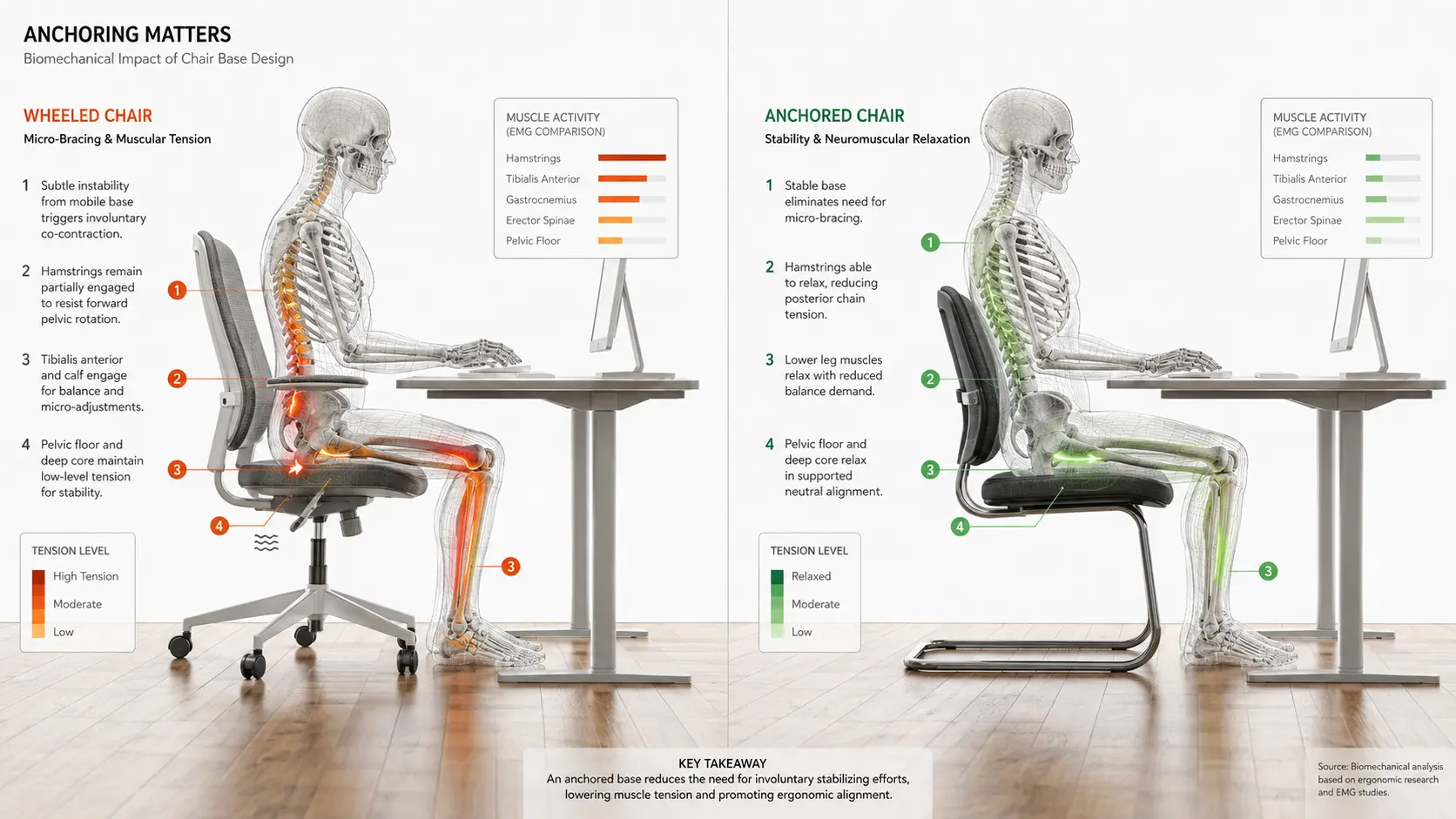
📌 Visual Explainer 1: Biomechanical grounding analysis. The left viewport illustrates constant involuntary muscle strain (highlighted in red vectors) along the calves and hamstrings when stabilizing rolling casters. The right viewport shows complete core relaxation through an anchored, stationary foundation.
Three Pillars of a Superior Stationary Ergonomic Task Chair
Many stationary chairs on the consumer market are rigid guest or conference seats that lack basic ergonomic adjustability. A high-performance ergonomic office chair no wheels built for full-time work must integrate three fundamental engineering criteria:
A. Cantilever Sled Base vs. Heavy-Duty Bell Glides
Stationary seating uses two primary base configurations. Sled-base cantilever frames distribute weight across two continuous horizontal steel tubes, offering a slight natural bounce that reduces tailbone impact when sitting down. Alternatively, five-star pedestal bases equipped with industrial bell glides retain 360-degree swivel and pneumatic height adjustment while keeping the chair securely planted in one spot.
B. Independent Sacral-Lumbar Curve Bracing
Omitting casters does not reduce the need for spinal support. An authentic wheel-free task chair must incorporate an anatomically curved backrest with height-adjustable sacral tracking. Without this support, users tend to perch forward on the front edge of the seat, which flattens the natural lordotic curve of the spine during long typing sessions.
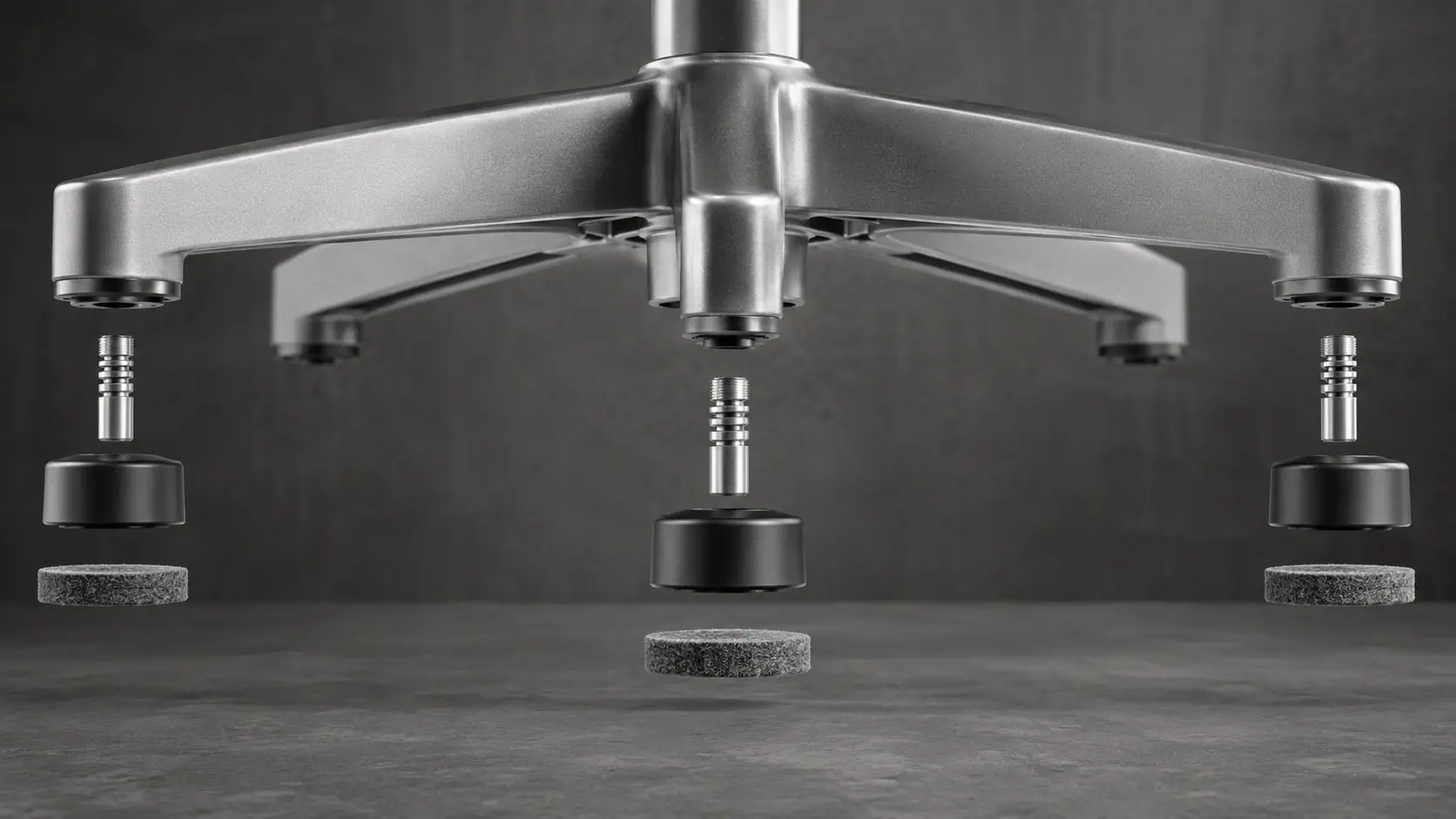
📌 Visual Explainer 2: Engineering detail of floor-safe stationary glides. Showcasing solid steel grip stems and dense, non-marking felt polymer pads that prevent sliding and protect delicate flooring.
Head-to-Head Base Architecture Specification Table
| Engineering Feature | Cantilever Sled-Base Task Frame | Swivel Base with Bell Glides |
|---|---|---|
| Floor Contact Footprint | Continuous dual rail tubing (Ideal for high-pile carpet) | 5 discrete 2-inch diameter circular pads |
| Height Adjustability | Fixed mechanical height (Requires height-matched desk) | Full 4-inch pneumatic Class-4 gas-lift travel |
| Axial Rotation | 0° (Fixed forward orientation) | Smooth 360° rotational bearing swivel |
| Hardwood Floor Safety | Safe with poly-carbonate rail floor protectors | 100% scratch-free with compression felt bases |
Lifestyle Clusters: Matching Stationary Designs to Your Flooring
To ensure an ideal ergonomic setup, match your stationary base design to your specific flooring and daily workflow:
🎹 The Audio Engineer & Flight Sim Specialist
If your workstation involves foot pedals, rudder controls, or precision studio equipment, a rolling chair creates constant issues. A stationary swivel chair with bell glides locks your seat firmly in place, keeping your feet aligned with your pedals without unwanted movement.
🪵 The Hardwood Minimalist & Active Crafter
If your home office features delicate solid oak, bamboo, or tile floors that you want to keep scratch-free, avoid heavy rolling wheels. A sled-base mesh chair equipped with non-abrasive glider pads spreads your weight evenly, protecting your floors from scratches and scuffs.
The Dynamic Station: Anchored Seating with Smart Standing Desks
Because stationary sled-base chairs often feature a fixed seat height, pairing them with a traditional, static 29-inch desk can create ergonomic problems. If the desk surface does not match your seated elbow height, you are forced to hunch your shoulders or crane your neck forward. Combining a wheel-free chair with an electric standing desk solves this issue completely.
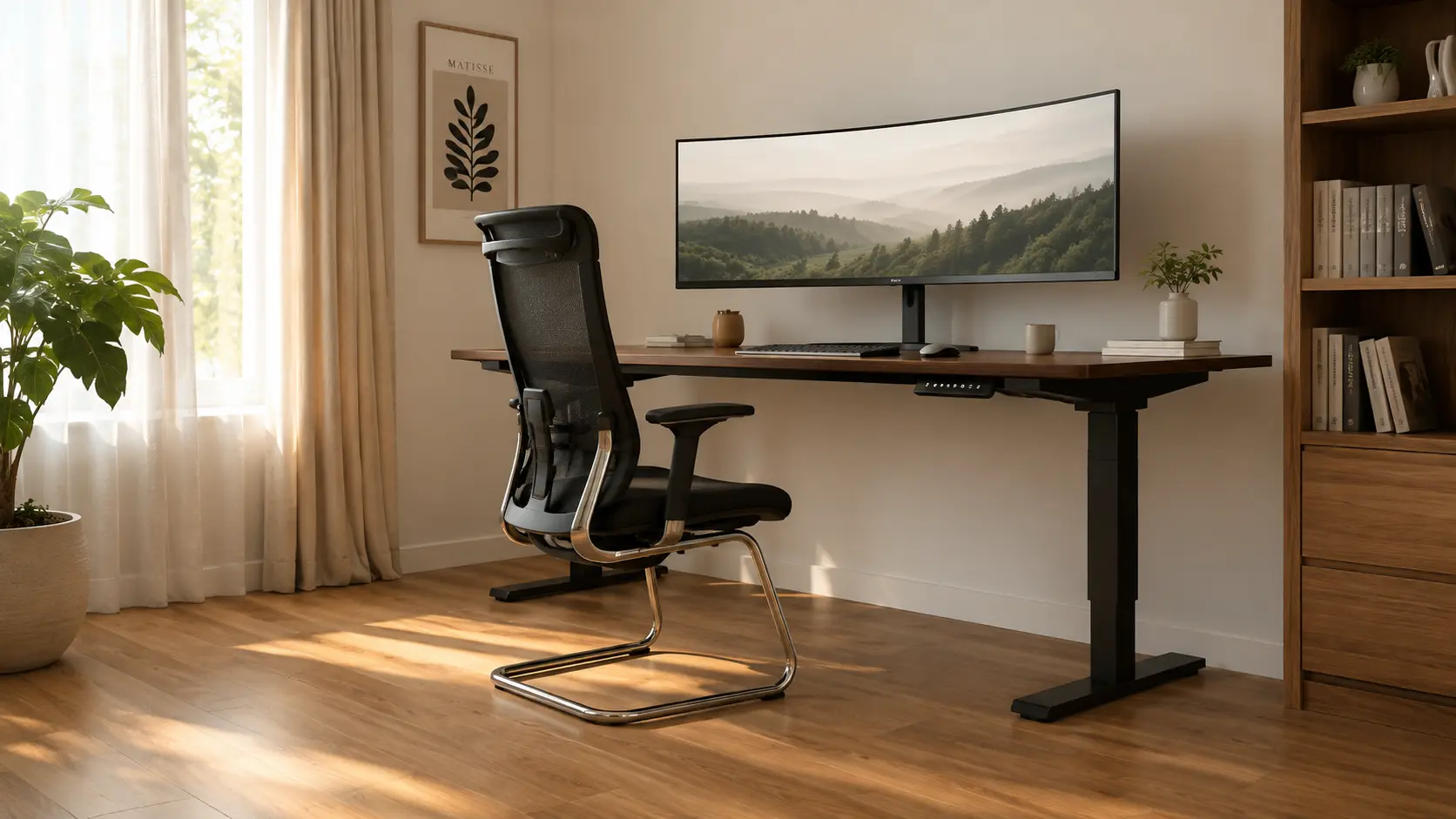
📌 Visual Inspiration 3: Clean, anchored home workstation. Pairing a stationary mesh chair with a programmable electric standing desk protects delicate flooring while keeping displays aligned precisely at eye level.
Using an adjustable workstation—such as the heavy-duty FlexiSpot Standing Desk series—lets you dial in your desk height to the exact millimeter. This guarantees that when seated in your stationary chair, your forearms rest completely parallel to the desk surface, eliminating the shoulder strain and wrist extension that cause typing fatigue.
Retrofit Engineering: Converting Premium Mesh Chairs with Bell Glides
If you already own an elite office chair like the Herman Miller Aeron, Steelcase Leap, or an ergonomic gaming chair, you do not need to replace it to get a stationary setup. Over 95% of commercial office chairs use a standard 7/16-inch by 7/8-inch (11mm x 22mm) grip-ring caster stem. By purchasing a set of aftermarket heavy-duty **stationary bell glides**, you can pop out the factory wheels and slide in stationary pads in under two minutes. This quick modification stops unwanted rolling completely while preserving all your chair’s original adjustments, including height, recline, and lumbar support.
Frequently Asked Questions (FAQs)
Can an ergonomic chair without wheels help improve posture and focus? ▼
Yes. Stationary chairs eliminate the involuntary micro-movements caused by rolling casters on smooth floors. Because your chair remains firmly in place, your core, hamstrings, and calves do not need to constantly brace against sliding, keeping your feet planted and allowing your spine to stay resting securely against the lumbar support.
Will converting a chair to bell glides lower the seat height significantly? ▼
Replacing standard 2-inch to 2.5-inch rolling casters with low-profile stationary bell glides typically lowers the overall chair height by approximately 0.5 to 1 inch. You can easily offset this minor difference by raising the pneumatic gas lift slightly to preserve your ideal 90-degree knee bend.
Are sled-base chairs safe for deep, plush carpeted home offices? ▼
Sled-base chairs perform exceptionally well on carpets. While small caster wheels sink deeply into thick carpet piles and leave crushed tracks, a sled base distributes weight across two continuous rails. This prevents deep indentations, reduces wear on carpet fibers, and keeps your chair stable without requiring an ugly plastic floor mat.