Affiliate Disclosure: ErgoSetupPro is reader-supported. When you buy through links on our site, we may earn an affiliate commission at no extra cost to you. We break down complex workplace mechanics and furniture blueprints to help you make informed workspace decisions.
What Are Ergonomic Chairs? The Ultimate Postural Engineering Starter Guide
Walk into any modern corporate office across North America or browse through high-end workspace setups on social media, and you will consistently hear a specific piece of furniture praised as a health necessity. If you have spent hours sitting at a desk only to log off with stiff shoulders, an aching lower back, or heavy legs, you are likely asking yourself: what are ergonomic chairs, and how do they differ from the standard seating found in typical retail stores? At its core, an ergonomic chair is not just a standard seat with added cushions; it is a highly adjustable, mechanically engineered device designed to adapt to your unique body frame, support your spine, and lower structural physical fatigue during long desk sessions.
📋 Inside This Introductory Blueprint
- 1. The Core Definition: Human-Centric Workspace Engineering
- 2. The Structural Problem: How Traditional Seating Harms Your Posture
- 3. Anatomy of a Solution: 5 Critical Mechanical Components
- 4. Comparison Matrix: Ergonomic Chairs vs. Standard Office Furniture
- 5. The Investment Value: Are These Specialized Chairs Worth It?
- 6. Workspace Synergy: Integrating Smart Seating with Motor Standing Desks
- 7. Frequently Asked Questions (Anatomy & Buying Schema)
🚨 Are you already experiencing acute spinal pain? If you don’t need the basic definitions and want to go straight to specific medical-grade product recommendations, skip this introductory guide and jump right to our expert teardown of the Best Ergonomic Office Chairs for Lower Back Pain Relief.
The Core Definition: Human-Centric Workspace Engineering
To truly answer what are ergonomic office chairs, we must look at the science of ergonomics itself. The term stems from the Greek words *ergon* (work) and *nomos* (natural laws). Therefore, an ergonomic furniture piece is one explicitly built to fit the natural laws and dimensions of the human body, rather than forcing the body to deform itself to fit a rigid object.
Unlike standard consumer furniture mass-produced to a single static dimension, an elite posture chair treats body diversity as a variable factor. Whether you are 5’2″ or 6’4″, these chairs feature a modular array of mechanical levers, gas cylinders, and pivot points. This design allows you to adjust every contact plane—from the seat depth slider to the sacral tracking panel—ensuring your skeletal joints settle into a safe, neutral resting posture.
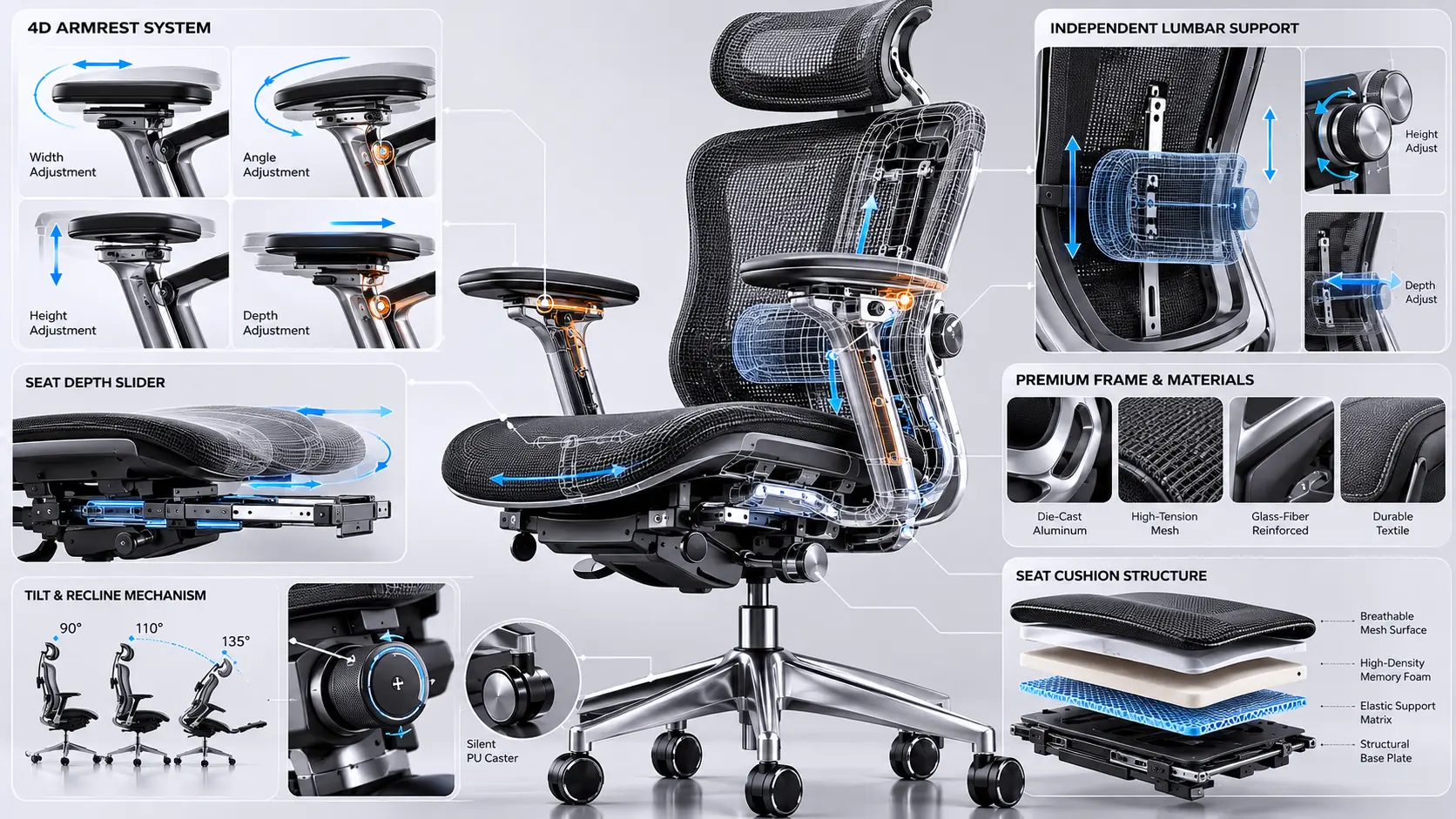
📌 Visual Explainer 1: Structural engineering breakdown. Highlighting the primary articulated support layers required to keep a user’s skeletal joints perfectly aligned over long sessions.
The Structural Problem: How Traditional Seating Harms Your Posture
When you sit on a standard wooden dining chair, a basic kitchen stool, or a cheap office seat, you are placing your body into a static, unyielding mold. Because these surfaces lack a dedicated lumbar curve or adjustable support depth, your pelvis automatically rolls backward into a position called posterior pelvic tilt. This rotation flattens out your lower back’s natural ‘S’ shape, curving it into a harmful, hunched ‘C’ profile.
This structural collapse increases the localized pressure on your L4 and L5 spinal discs by up to 150% compared to standing. Over a multi-hour shift, this continuous downward compression squashes your spinal tissues, restricts circulation, and pinches delicate nerve roots. The result is a cascade of physical strain: deep lower back aches, tight hamstrings, hunched shoulders, and painful muscle knots across your neck and upper torso.
Anatomy of a Solution: 5 Critical Mechanical Components
To ensure a model provides real, long-term support rather than just cosmetic style, look for these five critical adjustable mechanical features:
1. Height and Depth Adjustable Lumbar Bracing
Proper posture support begins at the sacrum—the bony base of your spine. A quality chair must allow you to adjust the lower back panel both vertically (to line up with your natural curve) and horizontally (to control how firmly it supports you). This customized bracing acts as a physical guide, preventing your lower back from slouching forward during long typing sprints.
2. Seat Depth Slider Mechanism
The length of users’ thighs varies significantly. A fixed seat pan that is too deep presses against the back of your knees, slowing circulation and forcing you to slide your torso forward away from the backrest. A built-in seat depth slider allows you to shift the seat pan forward or backward, maintaining a proper two-to-three finger gap behind your knees so your upper body rests securely against the lumbar support.
3. Synchronized Recline Weight Distribution
When exploring what are ergonomic office chairs built for long sessions, pay close attention to the tilt mechanism under the seat. Basic office chairs lean back in a fixed 1:1 ratio, which lifts the seat lip, tilts your thighs upward, and pinches blood vessels. A premium synchro-tilt mechanism reclines the backrest at a 2:1 ratio relative to the seat pan. This opens up your hip angle smoothly, keeping your feet flat on the floor and naturally decompressing your lower spine.
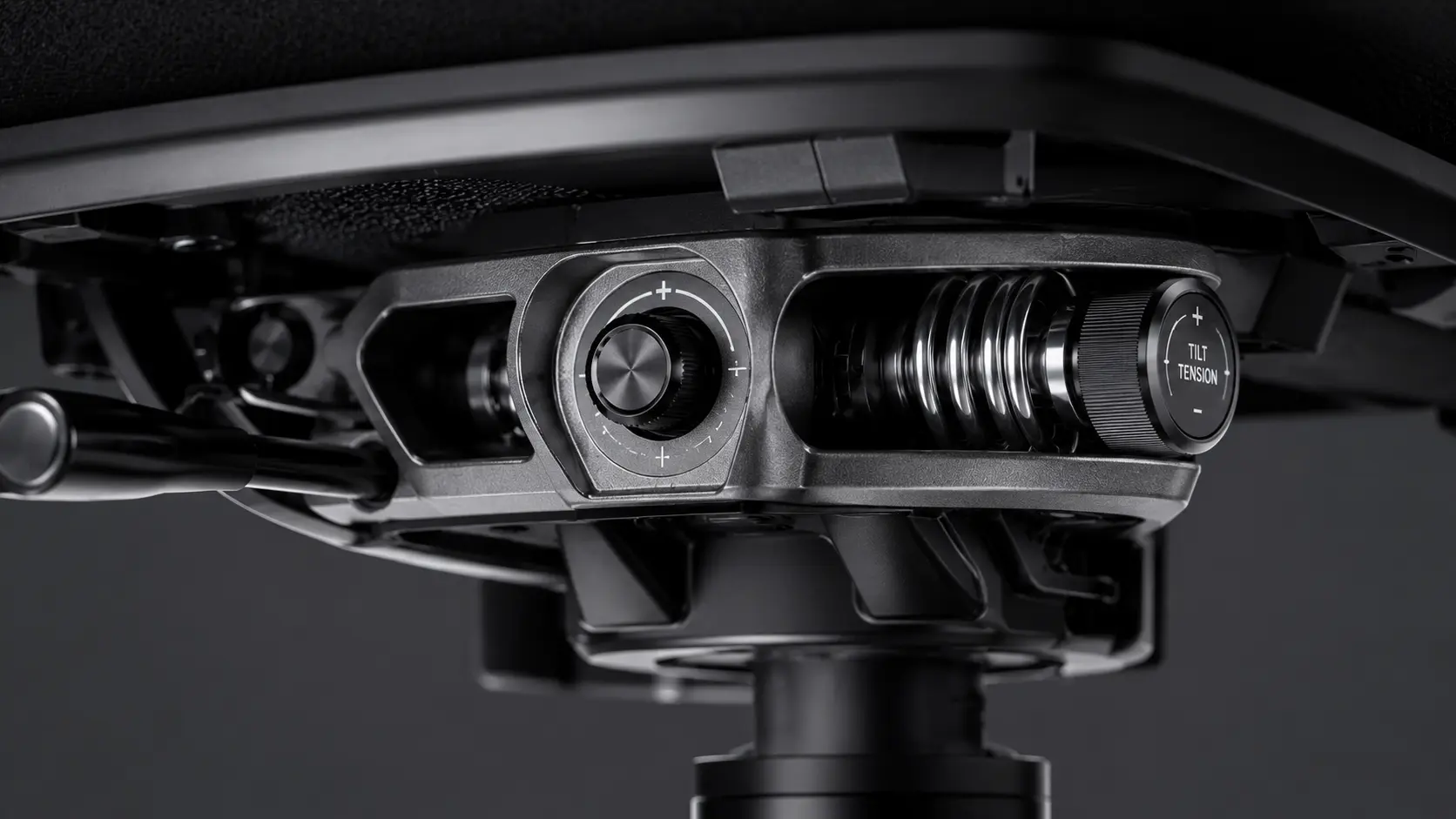
📌 Visual Explainer 2: Under-seat mechanical core. High-grade cast aluminum tension systems enable smooth posture adjustments while maintaining solid structural stability.
4. Fully Articulated 4D Armrests
Your arms account for roughly 10% of your total body mass. Leaving your elbows hanging completely unsupported pulls down on your shoulder and neck muscles, causing severe fatigue across your trapezius. Advanced 4D armrests adjust in height, depth, width, and inward pivot angle, supporting your forearms perfectly whether you are typing on a keyboard or gaming with a controller.
5. Multi-Zone Suspension Mesh
Traditional foam cushions trap body heat and can flatten down over months of continuous sitting. High-performance models use elastomeric polymer mesh woven with varying tension zones. These flexible zones cradle your pelvic bones and tailbone evenly, dispersing pressure points while providing continuous air ventilation to keep you cool and focused all day.
Comparison Matrix: Ergonomic Chairs vs. Standard Office Furniture
| Feature Set | Elite Posture Task Chair | Standard Office Chair |
|---|---|---|
| Lumbar Integration | Height and depth variable mechanisms matching natural spinal curves | Fixed flat frame backrest forcing a slumped posture |
| Arm Cushion Support | 4D articulation adjusting to arm length and keyboard stance | Fixed plastic or loop structures offering zero adaptability |
| Recline Movement | Synchronized recline expanding the hips while keeping feet flat | Basic 1:1 rear pivot that pinches blood vessels behind thighs |
| Warranty Certification | 5 to 12-Year commercial-grade manufacturing protection | 90-Day or 1-Year limited residential warranty lifespan |
The Investment Value: Are These Specialized Chairs Worth It?
When looking at options online, beginners are often surprised by the premium price tags of authentic ergonomic seating, which typically range from $400 to over $1,200. This brings up an important question: are ergonomic office chairs worth it? When evaluated as a long-term asset for your health and daily focus, the upfront investment is highly cost-effective compared to cheap, basic furniture alternatives.
A cheap residential seat often breaks down within a year because its thin padding flattens and its weak gas lifts fail under regular use. Premium commercial task options are built with rugged aluminum bases, high-grade Class-4 cylinders, and tear-resistant mesh certified for round-the-clock office use. Backed by extensive 12-year warranties, these investments cost mere cents per day over their operational lifespan while actively protecting your body from long-term medical care expenses.
Workspace Synergy: Integrating Smart Seating with Motor Standing Desks
Even when sitting in a top-tier posture chair, medical research indicates that staying completely stationary for a full 10-hour shift slows down circulation and leads to muscle fatigue. True remote workspace health requires introducing movement into your routine. This is why pairing an adaptive mesh chair with an electric, programmable standing desk provides a highly effective, focus-first office setup.
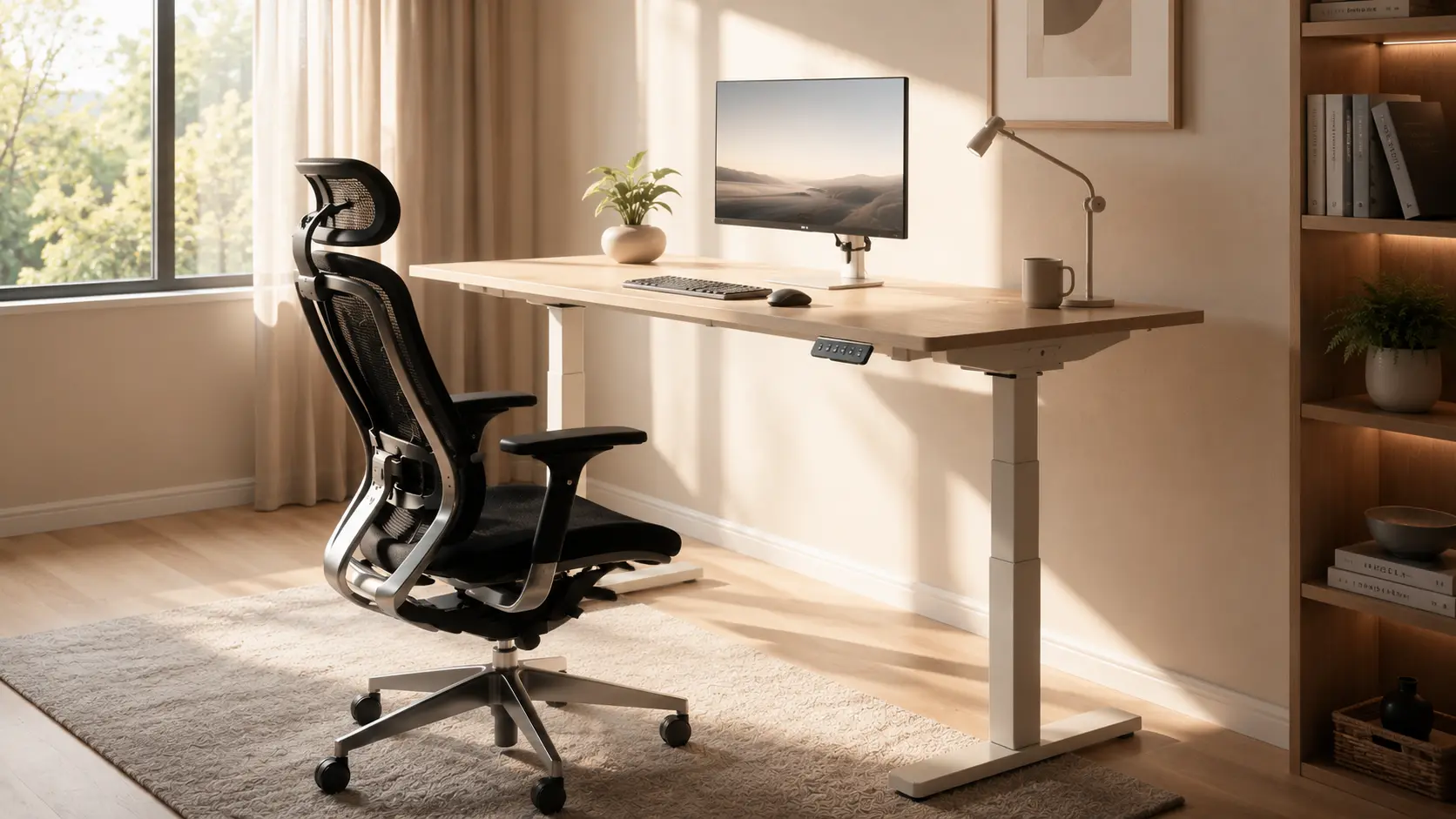
📌 Visual Inspiration 3: Clean, ergonomic remote workspace layout. Swapping between a supportive task chair and an active standing posture helps keep your circulation moving and prevents lower back fatigue.
Alternating between seated focus and standing workflows for just 15 minutes every hour decompresses your lower spinal discs, activates major core stabilizer muscles, and improves circulation. Using an advanced adjustable system—such as the heavy-duty FlexiSpot Standing Desk series—allows you to save customized, one-touch memory height presets. This guarantees that whether you stand to tackle an urgent project or sit back in your mesh chair, your screens align precisely with your eye level, preventing the forward slouching that ruins your focus.
Frequently Asked Questions (FAQs)
What are ergonomic chairs exactly, and how do they differ from normal chairs? ▼
Standard office furniture features a single, fixed size that forces users’ bodies to conform to its dimensions. In contrast, authentic ergonomic chairs use highly adjustable parts—such as 4D articulated armrests, seat pan depth sliders, and variable sacral bracing—to adapt cleanly to your unique body frame, keeping your skeletal joints in a safe, neutral resting posture.
Why is a seat pan depth slider critical for preventing leg numbness? ▼
If your seat surface is too deep for your thighs, its edge presses directly against the back of your knees, compressing delicate blood vessels and slowing circulation. A proper seat slider mechanism allows you to slide the cushion forward or backward, keeping your thighs fully supported while maintaining a comfortable two-to-three finger gap behind the knees.
Is multi-zone mesh or high-density foam better for continuous sitting? ▼
Premium multi-zone suspension mesh generally performs better for long sessions because it dynamically adjusts to your unique body shape and manages heat. While high-density foam offers thick initial cushioning, it can compress over multi-hour sits and lose its protective structural shape.